

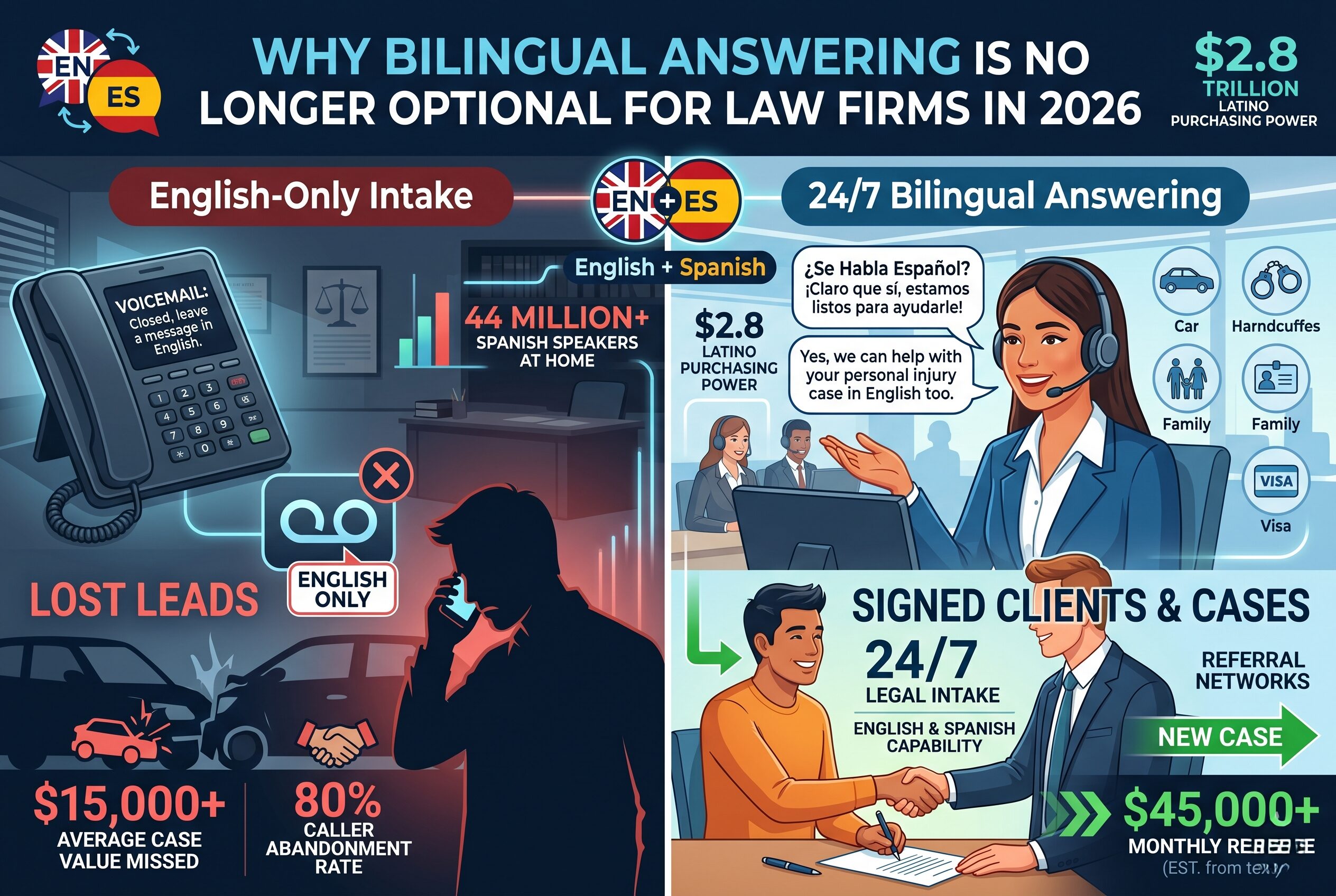
A Spanish-speaking caller dials your law firm at 6:30 PM on a Tuesday. She was rear-ended on the highway two hours ago. Her neck hurts, the other driver's insurance company is already calling, and she needs legal help now.
Your phone rings. Your office is closed. The voicemail greeting plays in English only.
She hangs up. She calls the next firm on Google. That firm answers in Spanish. That firm signs the case.
This scenario is not hypothetical. It is happening at law firms across the country every single day — and the numbers behind it should concern every firm owner who is serious about growth.
The Numbers That Should Change Your Mind
According to the most recent U.S. Census Bureau data, 44.9 million Americans speak Spanish at home. That figure has grown more than fourfold since 1970, making the United States the second-largest Spanish-speaking country in the world behind Mexico.
For law firms, this translates directly into client volume. Hispanic Americans are involved in car accidents, workplace injuries, criminal cases, family disputes, and immigration matters at the same rates as any other demographic. The difference is that when they pick up the phone to call a lawyer, many of them are more comfortable communicating in Spanish — especially under stress. And stress is exactly when people call law firms.
Why the First 60 Seconds Matter More in Spanish
Legal intake is already a high-stakes conversation in any language. The caller is often scared, confused, or in pain. They are deciding in the first minute whether they trust this firm enough to share the details of their situation.
A Spanish-speaking caller who reaches an English-only receptionist faces an immediate decision: struggle through in a second language during one of the worst moments of their life, or hang up and find someone who speaks theirs. Most hang up. Research consistently shows that 80% of callers who reach voicemail do not leave a message — with a language barrier, that abandonment rate is even higher.
The firms that answer in Spanish do not just capture one additional case. They capture an entire referral network. Hispanic communities are tightly connected through family and social networks. One positive experience with a bilingual law firm generates word-of-mouth referrals that English-only marketing cannot replicate at any price.

Bilingual intake doesn't just capture one case — it opens your firm to an entire referral network.
The Competitive Gap Is Still Wide Open
Despite the size of the Spanish-speaking market, most law firms still treat bilingual service as an afterthought. Some list "Se Habla Español" on their website but have no one available to actually take the call. Others rely on a single bilingual staff member who is only available during limited hours.
If your firm can answer calls in both English and Spanish, 24 hours a day, you are competing against firms that cannot. In practice areas like personal injury, criminal defense, family law, and immigration, this advantage compounds quickly.
The Revenue Opportunity — Personal Injury Alone
What Bilingual Intake Actually Requires
Offering bilingual service is not as simple as hiring one Spanish-speaking employee. Genuine bilingual intake requires three things working together:
-
1Coverage at all hours. Spanish-speaking callers do not limit their emergencies to business hours. A DUI arrest at midnight, a domestic violence incident on a Sunday, a car accident on a holiday — these all generate calls that need to be answered in the caller's language, immediately.
-
2Legal vocabulary, not just conversational fluency. A receptionist answering for a criminal defense firm needs to understand terms like arraignment, bond hearing, and probable cause in both languages. A receptionist handling personal injury intake needs to capture details about liability, medical treatment, and insurance coverage.
-
3Cultural competence. Tone, formality, and trust-building work differently across cultures. A bilingual receptionist trained in legal intake understands that a Spanish-speaking caller may need more reassurance, may be less familiar with the American legal system, and may have concerns that affect how they approach the conversation.
How the Best Firms Are Solving This
The firms getting this right are not trying to build bilingual capacity in-house. They are using answering services for law firms that include bilingual receptionists as a core feature rather than a premium add-on.
A full-time bilingual receptionist costs $40,000 to $55,000 per year in salary alone, covers one shift per day, takes vacations, and calls in sick. A professional bilingual answering service provides 24/7 coverage in both languages at a fraction of that cost — and the key differentiator is whether bilingual service is included or costs extra.
Many answering services charge a premium for Spanish-language calls, which creates a disincentive to route those calls properly. The best services include bilingual receptionists in every plan, treating Spanish-language intake as standard rather than optional.
The Practice Areas Where This Matters Most
| Practice Area | Why Bilingual Intake Is Critical |
|---|---|
| Personal Injury | Hispanic workers are overrepresented in high-injury industries like construction, agriculture, and manufacturing. Accident calls come in at all hours and require immediate intake in the caller's language. |
| Criminal Defense | Arrests happen at all hours. A Spanish-speaking family member calling about a DUI or assault charge at 2 AM needs a bilingual receptionist who understands the urgency and captures the right details. |
| Family Law | Divorce, custody, and domestic violence matters are deeply personal. Callers are far more likely to share sensitive details when communicating in their most comfortable language. |
| Immigration | By definition, immigration clients often have limited English proficiency. Spanish-language intake is not a nice-to-have — it is a functional requirement for serving this practice area. |

Firms with structured bilingual intake outperform English-only competitors in every practice area with significant Hispanic populations.
What to Look for in a Bilingual Answering Service
If your firm is evaluating bilingual answering options, here is what separates adequate from excellent:
-
Bilingual service included in every plan — no extra charge. If a provider charges more for Spanish calls, your team will hesitate to route them, and leads will fall through the cracks.
-
Fluent, not just conversational. Legal intake requires precision. The difference between "he hit my car" and "he ran a red light and T-boned me at 45 miles per hour" matters for case evaluation — and the receptionist needs to capture that accurately in either language.
-
Coverage must be 24/7. If bilingual receptionists are only available during business hours, you are missing the highest-value window: evenings, weekends, and holidays when callers have no other option.
-
Integrated with your existing systems. Call notes, intake forms, and appointment scheduling should work the same way regardless of what language the call came in. Your attorneys should not need a separate workflow for Spanish-language leads.
Bilingual Answering Is Included in Every Gabbyville Plan
No premium charges for Spanish calls. No separate workflow. Just trained bilingual receptionists available 24/7 for your firm.
Book a Free ConsultationNo obligation · 15–20 minutes · No long-term contracts
The Bottom Line
The math on bilingual answering is not complicated. Over 44 million people speak Spanish at home. Latino purchasing power exceeds $2.8 trillion. In practice areas like personal injury, criminal defense, family law, and immigration, Spanish-speaking callers represent a significant and growing share of potential clients.
Every firm that answers those calls in English only is leaving money on the table. Every firm that answers in both languages, 24 hours a day, with trained legal receptionists, is picking that money up.
The question is not whether bilingual answering matters. The question is how long your firm can afford to go without it.
Frequently Asked Questions
Ready to Stop Missing Spanish-Language Leads?
Gabbyville includes bilingual English-Spanish receptionists with every plan — trained in legal intake, available 24/7, at no extra charge.
Book a Free Consultation →15–20 minutes · No obligation · No long-term contracts
Last updated: May 2026